.png)

Runner-up
2015
Think Big
Challenge
Hyperoxia

Cellular hyperoxia
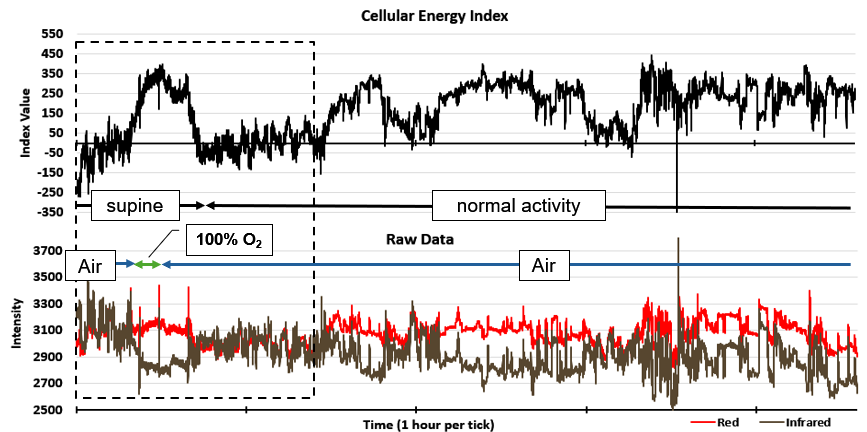
(Upper two graphs) In this study, the adult test subject laid on a surgical table and was fitted with an anesthesia machine breathing circuit and tight-fitting face mask. He initially breathed air, then was abruptly changed to breathing 100% oxygen at atmospheric pressure. His normal range of SpO2 is in the 98%+ range. A pulse oximeter was not used during this study. The duration of his exposure to normobaric 100% oxygen was about 12 minutes, after which the mask was removed and the subject remained supine for about 12 minutes; then stood up. No outward appearance or objective or subjective changes in his mental status were observed. The three prominent "spikes" seen in the Raw Data were purposely induced as time markers by pressing on the sensor, which decreases the amount of blood in the skin beneath the sensor, resulting in less absorption of both wavelengths of light and tandem increased detected intensity. He had inadvertently been breathing oxygen for a few minutes before he realized the change in breathing gas when he pressed the sensor the first time. The second timing mark was when he removed the mask, and the third just before he stood up.
Some observations: (1) the CEi trend immediately rose upon the first breaths of oxygen and continued to rise up to a maximum of about +400, (2) the CEi trend remained high even after he went back to breathing air while remaining supine (i.e., minimal exertion), and (3) the CEi trend decreased back to baseline immediately upon standing up and moving around. Pulse oximetry cannot detect these responses because there is no change in SpO2 once the arterial hemoglobin is fully saturated, even though the plasma oxygen tension (PaO2) continues to rise while breathing oxygen. The persistently elevated CEi indicates that the skin tissue beneath the sensor continued to be exposed to elevated oxygen tension in the blood plasma and interstitial and cellular fluids that exceeded cellular oxygen consumption. Upon standing, there was sufficient increased oxygen consumption by his muscles to decrease the circulating PaO2 back to baseline.
(Lower two graphs) This is the full 4.5+ hour recording, which started in a surgical operating room and continued through the remainder of the subject's work day as an anesthesiologist. The upper CEi and Raw Data graphs are the data segment outlined by the dashed-line boxes of this longer record. It is evident from this observational study that varying levels of activity had a measurable affect on the CEi trend through the remainder of his work day. Although not documented, the elevated CEi segments of this full recording were likely obtained when he was sitting and relatively inactive. The CEi trend apparently returned to baseline only while he was standing or walking. This is the first observation of the persistent CEi response to a brief exposure to high oxygen breathing.
Further studies are needed to fully document the CEi trend produced by the routine "pre-oxygenation," higher than atmospheric oxygen exposure during surgery, and extended exposure to elevated oxygen during observation in the post-anesthesia care unit (PACU) and in the intensive care unit (ICU). While blood plasma has relatively low oxygen carrying capacity compared with hemoglobin, oxygen is readily absorbed and retained by adipose tissue and, to a lesser degree by other tissues and interstitial and lymphatic fluids. As recorded in this brief observational study, accumulation and retention of oxygen by various tissues and body fluids is apparently enabled by breathing an elevated level of oxygen. Subsequent consumption of this accumulated oxygen may take up to several hours depending of the level and duration of exposure and the work load. This "tissue and body fluid oxygen retention" phenomenon is apparently not discernible in blood gas measurements or pulse oximetry monitoring. The common liberal use of oxygen prior to, during and following surgical anesthesia, and throughout intensive care is currently assumed to be both needed as a means of preventing episodes of hypoxemia and harmless. The above CEi data provides a small sample of the potentially useful new information that is now available for investigation of several currently unexplained problems associated with medical oxygen therapy. These problems range through the human lifespan from retinal detachment, brain injury and hemorrhage, and gut damage in premature infants to post-anesthesia delirium and cognitive decline in elderly surgical anesthesia patients.
The introduction of pulse oximetry was initially resisted because it was viewed by clinical experts as less accurate than blood gas. However, when pulse oximetry recorded episodes of severe hypoxemia during surgery that were missed by timed and often "staged" blood gas measurements, pulse oximetry quickly became, and continues to be, required during surgical anesthesia. As a potential repeat of the history of pulse oximetry, we propose that CEi's detection of cellular hyperoxia during and following exposure to high oxygen breathing gas, which cannot be detected by blood oxygen measurements, is likely to lead to significant changes in anesthesia practice specifically, and to medical oxygen therapy in general.